
If you’ve landed here, you likely searched for something like “cinematography course in Kenya,” “what is cinematography,” or “cinematography vs videography.”
You’re in the right place.
This guide explains:
- What cinematography really means (and how it differs from videography and TV production)
- The skills you need to become a cinematographer in Kenya
- Where to learn those skills in Nairobi – even without a “standalone” cinematography degree
Let’s clear up the confusion first.
What is Cinematography?
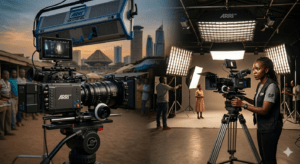
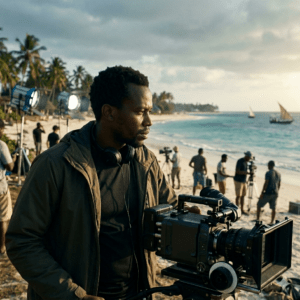
Cinematography is the art and science of capturing moving images on camera – but with intent.
A videographer records an event. A cinematographer tells a story with light, camera movement, lens choice, composition, and color.
Think of these famous Kenyan scenes:
- The golden, dust-filled light in Nairobi Half Life
- The tense close-ups in Supa Modo
- The sweeping drone shots of the Rift Valley in Rafiki
That’s cinematography at work.
Cinematography vs Videography vs TV/Film Production
Many Kenyans use these terms interchangeably. But for your career, the differences matter.
| Role | Primary Focus | Typical Clients in Kenya |
|---|---|---|
| Cinematographer (Director of Photography) | Narrative storytelling, lighting design, camera movement | Film, high-end commercials, music videos, documentaries |
| Videographer | Event coverage, quick turnaround, solo shooter | Weddings, church events, YouTube content, corporate interviews |
| TV/Film Production | Full production pipeline (script to screen) | TV stations, production houses, streaming platforms |
Here’s the important point for Kamata College students:
We do not offer a standalone “Cinematography Certificate.”
But you learn cinematography skills inside two of our practical courses:
- TV and Film Production – Covers narrative cinematography, blocking, lighting for story, and directing the camera.
- Photography and Videography – Covers exposure, composition, color, and camera handling – the technical foundation every cinematographer needs.
Why separate them? Because a wedding videographer needs different skills than a film DOP. But both need the visual language that cinematography provides.
Why “Cinematography” is a Growing Search Term in Kenya
Over the last three years, Google searches for “cinematography course in Kenya,” “cinematography salary,” and “cinematography vs videography” have increased significantly.
Why?
- More Kenyan films on Netflix and Showmax – Audiences now see high-quality local storytelling and ask, “Who shot that?”
- Music video culture – Gengetone, hip-hop, and gospel videos now use cinematic lighting and camera movement.
- Freelance economy – Young creatives want to charge higher rates as a “cinematographer,” not just a “videographer.”
- Short courses – People want focused skills, not a three-year degree.
If you ignore the keyword “cinematography,” you lose students who are ready to pay for premium visual storytelling skills.
Core Cinematography Skills You Can Learn (Without a Dedicated Degree)
You do not need a film school degree to become a cinematographer. You need these seven skills – all of which we teach inside our existing courses.
1. Camera Exposure & Composition
- The exposure triangle (aperture, shutter speed, ISO)
- Rule of thirds, leading lines, framing
- Where you learn this at Kamata: Photography and Videography course (Module 1 & 2)
2. Lighting for Mood & Story
- Three-point lighting (key, fill, back)
- High-key vs low-key lighting
- Using natural light (golden hour in Kenya)
- Where you learn this: TV and Film Production course (Cinematography module)
3. Camera Movement
- Static, pan, tilt, dolly, handheld, gimbal
- When to move (and when to stay still)
- Where you learn this: TV and Film Production (practical shoots)
4. Lenses & Focal Length
- Wide vs telephoto vs prime lenses
- Depth of field (blurry background vs everything sharp)
- Where you learn this: Photography and Videography course (gear sessions)
5. Color & Grading
- White balance, color temperature
- Introduction to DaVinci Resolve
- Where you learn this: Both courses (editing modules)
6. Shot Design & Storyboarding
- Shot sizes (wide, medium, close-up, extreme close-up)
- Camera angles (low angle, eye level, high angle)
- Where you learn this: TV and Film Production (scriptwriting & directing)
7. Working with a Crew
- Communicating with directors, gaffers, grips
- On-set etiquette
- Where you learn this: TV and Film Production (group projects)
Cinematography Careers in Kenya (Realistic 2026 Outlook)
| Role | Entry-Level Monthly Income (KES) | Experienced (KES) |
|---|---|---|
| Music video DOP | 20,000 – 50,000 per video | 80,000 – 150,000+ |
| Corporate cinematographer | 30,000 – 60,000 | 80,000 – 120,000 |
| Documentary DOP | 25,000 – 55,000 per project | 70,000 – 150,000 |
| Film DOP (feature) | 100,000 – 300,000 per film | 500,000 – 1M+ |
| Wedding cinematographer | 15,000 – 40,000 per wedding | 60,000 – 120,000 |
Note: Most cinematographers in Kenya freelance. Income varies by season, network, and portfolio quality.
Who hires cinematographers in Kenya today?
- Production houses
- Advertising agencies (for TV commercials)
- Music labels (especially gospel and gengetone)
- NGOs (documentaries)
- Streaming platforms (Showmax, Netflix Kenya originals)
How to Start Learning Cinematography in Nairobi (Without Wasting Time)
Here is a practical 6-month path using Kamata College’s existing courses.
Month 1-3: Master the Camera (Photography & Videography Course)
- Shoot in manual mode
- Understand exposure, focus, and white balance
- Complete 10 still photography assignments (portraits, products, landscapes)
- Outcome: You can operate any DSLR or mirrorless camera blindfolded.
Month 4-6: Add Story & Movement (TV & Film Production Course)
- Learn three-point lighting
- Shoot a short narrative scene (30 seconds)
- Edit with color grading
- Work as camera assistant on a real project
- Outcome: You can light a scene, move the camera with purpose, and call yourself a junior cinematographer.
Optional Month 7-9: Specialize
- Advanced lighting (night shoots, fire, water)
- Gimbal & drone operation
- DaVinci Resolve certification
Frequently Asked Questions (From Kenyans Searching “Cinematography”)
1. Is cinematography a good career in Kenya?
Yes – but only if you combine skill + business sense. Pure technical ability is not enough. You also need networking, pricing, and basic marketing. Kamata students learn entertainment management alongside camera skills.
2. Do I need a university degree to become a cinematographer?
No. Most working cinematographers in Kenya are self-taught or took short courses. Employers and clients care about your reel (portfolio), not your certificate.
3. What camera should I buy as a beginner in Kenya?
Start with:
- Under 50,000 KES: Used Canon 200D or Sony a6000 (body only) + 50mm f/1.8 lens
- 50,000 – 100,000 KES: Sony a6400 or Canon 90D
- Over 100,000 KES: Blackmagic Pocket Cinema Camera 4K or Sony A7iii
Tip: Rent first. Nairobi has rental houses (e.g., Camera Solutions, ZIMMO) with Blackmagic, RED, and Sony FX6.
4. How long does it take to learn cinematography?
- Basics (exposure, composition): 3 months
- Intermediate (lighting, movement): 6 months
- Advanced (narrative, color grading, crew work): 9–12 months
At Kamata, you can complete our TV and Film Production course (9 months) or Photography & Videography course (6 months) – or both.
5. Can I learn cinematography online for free?
Yes, but with limits. YouTube channels like DSLRguide, Cinematography Database, and Aputure teach well. However, in Kenya, you need hands-on practice with gear (lights, cameras, modifiers) and feedback from a teacher – which online courses don’t provide.
So, Does Kamata College Teach Cinematography?
Direct answer: We do not have a standalone course called “Cinematography Certificate.”
Honest answer: Yes – you learn cinematography skills inside our TV and Film Production course (narrative, lighting, camera movement) and our Photography and Videography course (exposure, composition, color).
Why do we separate them?
Because a music video DOP needs different skills than a wedding videographer. By learning both, you become a versatile visual storyteller – ready for any client.
Your Next Step (If You Want to Learn Cinematography in Nairobi)
- Read the full course pages:
- Visit our school in Nairobi CBD – see the equipment, meet instructors, and watch student reels.
- Start with one course (we recommend Photography & Videography first if you’re a complete beginner).
Final Word
Cinematography is not magic. It is light, camera, and intention – all of which can be learned.
You do not need a “cinematography degree” to call yourself a cinematographer. You need a reel that proves you can tell a story visually.
At Kamata College, we give you the tools, the practice, and the industry links. The rest is up to your creativity.
Still have questions?
Call us, WhatsApp, or visit. We’ll show you student work and help you choose the right path.
Kamata College – Nairobi CBD
Where Kenya’s next cinematographers start.