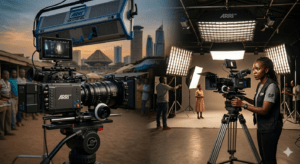

If you’re searching for “cinematography course in Nairobi” or “videography jobs Kenya,” you’ve likely seen these two titles used interchangeably.
They are not the same.
And the difference matters – because they pay differently, require different skills, and attract different clients.
This guide breaks down:
- The real difference between a cinematographer and a videographer
- What each earns in Kenya today (2026 rates)
- Which path matches your goals
- How Kamata College teaches both skill sets (without a standalone cinematography degree)
Quick Answer (For the Impatient)
| Role | Best for… | Typical Monthly Income (Entry) | Typical Monthly Income (Experienced) |
|---|---|---|---|
| Videographer | Weddings, events, corporate, YouTube | KES 15,000 – 30,000 | KES 40,000 – 80,000 |
| Cinematographer (DOP) | Music videos, films, high-end commercials, documentaries | KES 20,000 – 50,000 per project | KES 80,000 – 300,000+ per project |
But: Cinematographers work less frequently. Videographers eat every week.
Read on to understand why.
The Core Difference (In Simple Terms)
A videographer records what happens.
A cinematographer creates how it feels.
| Aspect | Videographer | Cinematographer (Director of Photography) |
|---|---|---|
| Primary goal | Capture an event accurately | Tell a story with light, camera movement, and mood |
| Typical client | Bride, pastor, CEO, YouTuber | Music label, film director, ad agency |
| Crew size | Often solo or one assistant | Works with gaffer, grip, camera team |
| Equipment | One camera, on-camera mic, basic tripod | Multiple lenses, professional lights, flags, rails, monitor |
| Planning time | Show up and shoot | Days of prep (shot lists, lighting diagrams) |
| Editing involvement | Often does own editing | Usually hands off to colorist/editor |
Real example from Nairobi:
- Videographer: Hired by a church to record Sunday service and testimonies. Uses one camera. Delivers 2-hour video by Wednesday.
- Cinematographer: Hired by a gospel artist to shoot a 4-minute music video. Spends 1 day planning, 2 days shooting with a crew of 4, then hands footage to editor. Final video looks like a movie.
Both are valid. Both pay. But they are different careers.
Income Breakdown in Kenya (2026 Real Rates)
These figures come from actual freelance rates, production house budgets, and graduate reports from Kamata College and other Nairobi creative schools.
Videographer Income
| Project Type | Typical Fee (KES) | Frequency |
|---|---|---|
| Wedding (full day + edited highlight reel) | 15,000 – 40,000 | Weekends (peak: Dec, Aug, Easter) |
| Corporate event (3 hours + 2-min recap) | 8,000 – 20,000 | Weekdays, inconsistent |
| YouTube shoot (2 hours studio) | 3,000 – 8,000 | Per session |
| Church service (weekly retainer) | 5,000 – 15,000/month | Steady but low |
Monthly realistic range for a full-time videographer in Nairobi:
- Beginner: KES 15,000 – 30,000
- 1-2 years experience: KES 35,000 – 60,000
- With editing & photography skills: KES 50,000 – 80,000
Cinematographer Income
| Project Type | Typical Fee (KES) | Notes |
|---|---|---|
| Music video (standard gengetone/gospel) | 20,000 – 60,000 per video | 1-2 shoot days + prep |
| High-end music video (with label budget) | 80,000 – 200,000 | Rare but exists |
| TV commercial (30-60 seconds) | 50,000 – 150,000 per day | Usually 1-3 shoot days |
| Corporate documentary (3-5 minutes) | 40,000 – 100,000 | Includes research & shoot days |
| Short film (15-30 minutes) | 30,000 – 80,000 total | Often low budget but good reel |
| Feature film (as DOP) | 150,000 – 500,000+ for entire shoot | 2-4 weeks of work |
But there’s a catch: A cinematographer might work only 5-10 projects per year. The rest of the time is networking, planning, or taking videography gigs to pay rent.
Which One Pays More? (The Honest Answer)
Per project: Cinematographer (2x to 5x higher)
Per year (consistent income): Videographer
Let’s calculate:
| Role | Projects per month | Avg fee | Monthly | Yearly |
|---|---|---|---|---|
| Videographer | 6-8 small gigs | KES 5,000 | KES 30k – 40k | KES 360k – 480k |
| Cinematographer | 1-2 big projects | KES 50,000 | KES 50k – 100k (but not every month) | KES 300k – 600k (unpredictable) |
Verdict: A successful cinematographer earns more per hour. A working videographer earns more consistently.
Most Kenyan camera professionals do both. They call themselves “videographers” on their wedding packages and “cinematographer” on their music video portfolio. That’s smart business.
Skills Comparison: What You Need to Learn
| Skill | Videographer | Cinematographer |
|---|---|---|
| Manual camera operation | Required | Required (advanced) |
| Exposure triangle | Required | Required (mastery) |
| Basic composition | Required | Required (mastery) |
| Three-point lighting | Helpful | Required |
| Gimbals & movement | Helpful | Required |
| Lighting for mood/story | Rare | Required |
| Shot listing & storyboarding | Rare | Required |
| Leading a crew | No | Yes |
| Color grading (basic) | Helpful | Required |
| Audio recording | Often required | Handed to sound team |
| Editing (fast turnaround) | Often required | Rare |
Where to learn these at Kamata College:
- Videography foundation: Photography and Videography course (3-6 months)
- Cinematography advanced skills: TV and Film Production course (9 months)
We do not offer a standalone “Cinematography Certificate.” But our students learn cinematography skills inside the TV/Film course (lighting for narrative, camera movement, shot design) and the Photography/Videography course (exposure, composition, color).
TV and Film Production course →
Photography and Videography course →
Which Career Should You Choose?
Choose Videography (first) if:
- You need to earn money quickly
- You enjoy event coverage (weddings, churches, graduations)
- You prefer working solo or with one assistant
- You want to learn editing and deliver fast
Choose Cinematography (eventually) if:
- You love storytelling and mood
- You want to work on films, music videos, or adverts
- You’re patient (bigger projects, less frequent)
- You’re willing to assist experienced DOPs first (unpaid or low pay)
The Smart Path (Recommended for most beginners):
- Month 1-3: Take Photography & Videography course. Learn camera basics, exposure, and composition. Start taking small paid gigs (events, portraits).
- Month 4-9: Take TV & Film Production course. Learn lighting, narrative, and crew work. Build a short film or music video for your reel.
- Year 1-2: Work as a videographer for a steady income. Take 1-2 cinematography projects per year for your portfolio.
- Year 3+: Transition to cinematography if your network and reel allow higher rates.
This is exactly how most working Directors of Photography (DOPs) in Kenya started – including those shooting for Netflix Kenya and major music labels.
FAQs on Cinematographer
Can I call myself a cinematographer without a degree?
Yes. Clients care about your reel, not your certificate. But you need training to build that reel.
Do I need to own expensive gear to start as a cinematographer?
No. Rent. Nairobi has camera rental houses with Blackmagic, Sony FX6, RED, and professional lighting. A 2-day rental for a music video costs KES 5,000 – 15,000 – less than buying.
Which pays more long-term?
Cinematographer – but only if you build a strong network and reel. Most plateau as videographers. The ones who study lighting, narrative, and crew management move up.
Does Kamata College offer a cinematography certificate?
Our TV and Film Production course covers cinematography (lighting, movement, shot design) and our Photography and Videography course covers the technical foundation. Many graduates work as junior DOPs.
Final Word
You do not need to choose “videographer” or “cinematographer” forever. Start with videography to pay bills. Add cinematography skills to raise your rates.
The best camera professionals in Nairobi do both – switching hats depending on the client and budget.
Your next step:
- Read our Complete Guide to Cinematography in Kenya →
- Visit Kamata College in Nairobi CBD to see the equipment and talk to instructors
- Start with the Photography & Videography course if you’re a beginner
Back to Complete Cinematography Guide | Read next: 5 Cinematography Lighting Techniques →